
022. Paul Bley
Instalment number four in the “Jazz in Canada” series focusing on the inexhaustible body of work of Canada's vice president of jazz piano. And a Bob Dylan sidebar, of course.

Pre-(r)amble
My family is in the middle of a move. After a couple disorienting days, I’m starting to settle in. Yesterday, I made vegetarian chili, our first home-cooked meal in the new place. After two days of takeout and cobbling together leftover fridge tidbits, I had a new appreciation for food made from scratch. It’s something I take for granted since I usually cook every night, but it struck me that home is so much about food and sharing meals together.
In my state of transience and new beginnings, and in the midst of the overriding North American neighbourhood political hogwashery going on, a Bob Dylan song came into my head, “The Ballad of Frankie Lee and Judas Priest,” from the John Wesley Harding (1967) album. The song wanders and meanders as Dylan tells a somewhat incomprehensible story imbued with tidbits of wisdom that have stuck with me through the years. I’ve included the lyrics below. In listening to the song, I can’t help but make parallels to the present day relationship between Canada and the United States. I’m still debating who is Judas Priest in the song, and who is Frankie Lee. But it’s more accurate to leave it ambiguous.
Well, Frankie Lee and Judas Priest
They were the best of friends
So when Frankie Lee needed money one day
Judas quickly pulled out a roll of tens
And placed them on a footstool
Just above the plotted plain
Sayin’, “Take your pick, Frankie Boy
My loss will be your gain”
We are living in the era where Canada and the US are no longer best friends. As Prime Minister Mark Carney recently said in a speech, “The era of deep economic, security, and military ties between Canada and the United States is over.”
Well, Frankie Lee, he sat right down
And put his fingers to his chin
But with the cold eyes of Judas on him
His head began to spin
“Would ya please not stare at me like that,” he said
“It’s just my foolish pride
But sometimes a man must be alone
And this is no place to hide”
Canada learning to stand alone. And furthermore, me needing some refuge from dealing with the movers, the landlord, the family. Seeking solace in the constant buzz buzz buzz of moving. And man and country taken out of everyday comforts, needing a quiet place to think and ponder new horizons, new possibilities, new identities.
Well, Judas, he just winked and said
“All right, I’ll leave you here
But you’d better hurry up and choose which of those bills you want
Before they all disappear”
“I’m gonna start my pickin’ right now
Just tell me where you’ll be”
Judas pointed down the road
And said, “Eternity!”
This one seems like Mark Carney is Judas, patient and unafraid. Trump is the eager Frankie Lee. It makes sense that Trump asked for a meeting with Carney shortly after the Prime Minister didn’t meekly bow down to the President.
“Eternity?” said Frankie Lee
With a voice as cold as ice
“That’s right,” said Judas Priest, “Eternity
Though you might call it ‘Paradise’”
“I don’t call it anything”
Said Frankie Lee with a smile
“All right,” said Judas Priest
“I’ll see you after a while”
Trump’s voice as cold as ice. Carney smugly referring to Canada as “paradise.” The classic orange wincing Trump smile, followed by Carney’s knowing that Trump will come running.
Well, Frankie Lee, he sat back down
Feelin’ low and mean
When just then a passing stranger
Burst upon the scene
Saying, “Are you Frankie Lee, the gambler
Whose father is deceased?
Well, if you are, there’s a fellow callin’ you down the road
And they say his name is Priest”
When doesn’t Trump feel low and mean? Is the passing stranger… Elon Musk?
“Oh, yes, he is my friend”
Said Frankie Lee in fright
“I do recall him very well
In fact, he just left my sight”
“Yes, that’s the one,” said the stranger
As quiet as a mouse
“Well, my message is, he’s down the road
Stranded in a house”
Trump insecurely asserting that Carney (Canada) is indeed his “friend.” The mousey Musk, omnipresent in the background.
Well, Frankie Lee, he panicked
He dropped ev’rything and ran
Until he came up to the spot
Where Judas Priest did stand
“What kind of house is this,” he said
“Where I have come to roam?”
“It’s not a house,” said Judas Priest
“It’s not a house . . . it’s a home”
Trump, ever panicked and unsure of how to approach Carney’s house of Canada. Carney assuring Trump that Canada is actually a real country, a home not a house.
Well, Frankie Lee, he trembled
He soon lost all control
Over ev’rything which he had made
While the mission bells did toll
He just stood there staring
At that big house as bright as any sun
With four and twenty windows
And a woman’s face in ev’ry one
Trump specializes in losing all control, does he not? And as he stares at the “big house," it reminds me of the history of the all the women he’s harassed and demeaned and who have come forth against him in court, Stormy Daniels included.
Well, up the stairs ran Frankie Lee
With a soulful, bounding leap
And, foaming at the mouth
He began to make his midnight creep
For sixteen nights and days he raved
But on the seventeenth he burst
Into the arms of Judas Priest
Which is where he died of thirst
While Trump has no soul to be full, he is indeed a rabid dog. I can only hope that one of these days, after all his vengeful rage, he will self-destruct, thirsty from acute moral dehydration.
No one tried to say a thing
When they took him out in jest
Except, of course, the little neighbor boy
Who carried him to rest
And he just walked along, alone
With his guilt so well concealed
And muttered underneath his breath
“Nothing is revealed”
Here’s where it gets tricky. Is Carney the guilty one? Is the little neighbour boy Justin Trudeau, playing a cameo?
Well, the moral of the story
The moral of this song
Is simply that one should never be
Where one does not belong
So when you see your neighbor carryin’ somethin’
Help him with his load
And don’t go mistaking Paradise
For that home across the road
This last verse brilliantly and succinctly illustrates a parable for our times. I thought of this song on a personal level, moving to a new neighbourhood. But it checks out on a continental level as well. We just have to agree on how to spell neighbor/neighbour.
PAUL BLEY (1932 - 2016)
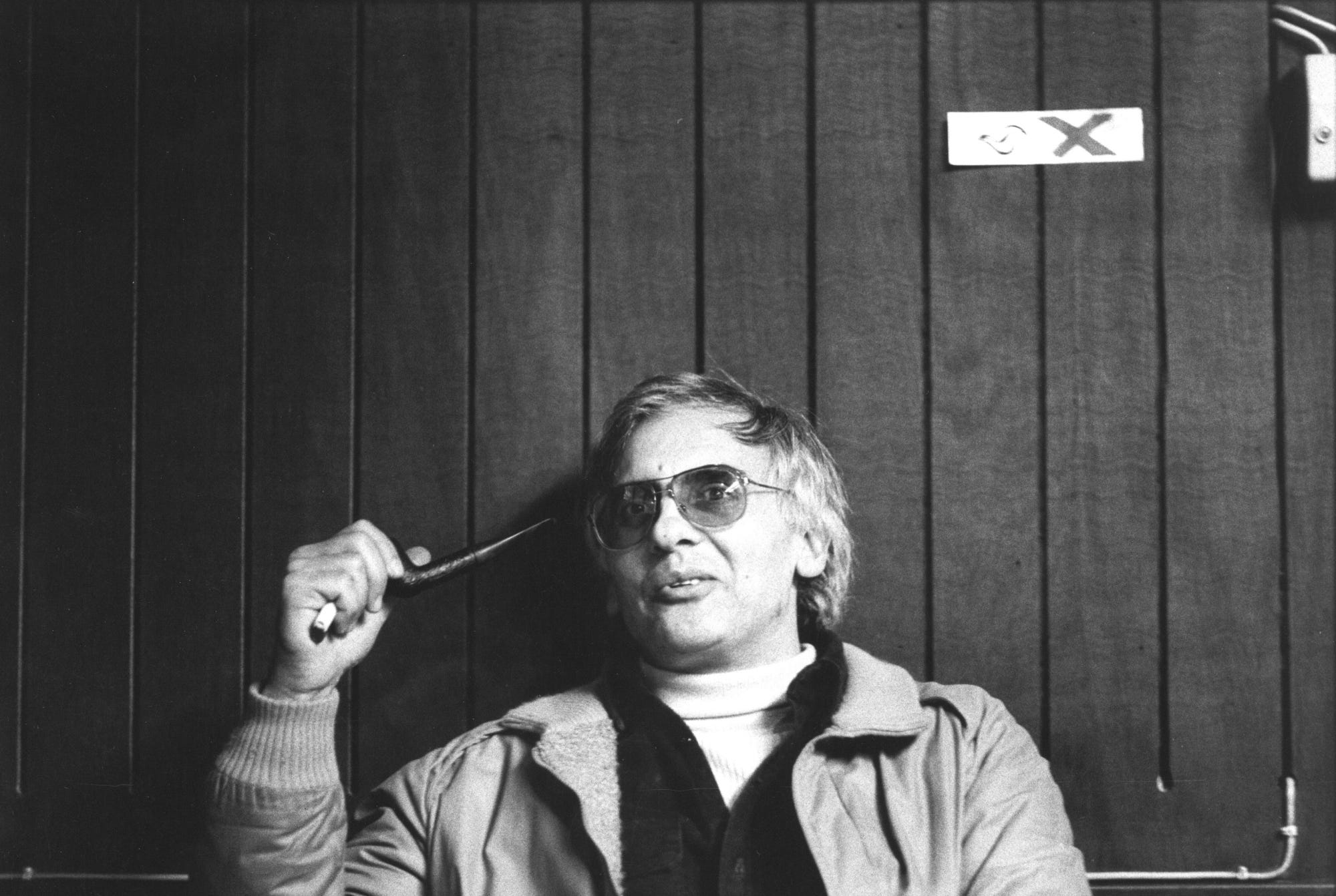
This week, I’ll continue with instalment number four in the “Jazz in Canada” series, covering Montreal-born pianist Paul Bley and highlighting his work with Canadian record label, Justin Time.
From the PENGUIN GUIDE:
The Canadian pianist is astonishingly prolific, having recorded over 100 discs down the years, by our reckoning. He is also extremely eclectic, ranging from free bop and ballads to electronic settings and larger groups. Consistently, though, he has produced vivid, vital jazz couched in an advanced and challenging idiom. Born in Montreal, he moved to New York, played in hard-bop groups and then crossed coasts to California, where he was nominal leader on one of Ornette Coleman’s most important documented live dates. Bley then began to develop his own distinctive style, built on unexpected harmonic shifts, a steady but subtly varied pulse and powerful melodic statements.
Paul Bley got his first break in Montreal in 1949 at seventeen years old, replacing Oscar Peterson (read my post on Peterson here) at the Alberta Lounge once Peterson left for New York City.
I first heard Paul Bley during my time at WNUR. In my early devotion to Mingus, I was intrigued to find Bley’s debut record, Introducing Paul Bley (1953). I thought to myself, “Who is this white boy that’s playing his debut album with Mingus and Art Blakey??”
The Penguin Guide calls the album an “astonishing debut with Mingus and Blakey, on which he sounds edgy and a little cautious on the standards but absolutely secure in his technique…”
As part of my Paul Bley research for this piece, I read Stopping Time: Paul Bley and the Transformation of Jazz, David Lee’s autobiography, culled from several interviews and tapes of Bley over a 10-year period. It was hard for me to connect with it; it felt removed and piecemeal. But I have to respect Bley; he’s occupied a singular place in the jazz world. In a book review from Doug Beardsley at Quill and Quire:
Bley’s analysis of the redundancy of the traditional form is highly informative, as are his reflections on the quest for atonality in jazz, and the attempt to move music “beyond its own limitations.” Also interesting is his chapter on the Hillcrest Club in Los Angeles in 1958, where he played with the unknown Ornette Coleman and Don Cherry. During that memorable gig, all the constraints of repetitive structure fell away.1
Bley came down from Montreal to New York to attend Juilliard in 1950, and recorded aforementioned debut with Mingus and Blakey three years later. After moving to Los Angeles in 1957, he hired then-unknown Don Cherry and Ornette Coleman as part of his live band at the Hillcrest Club, introducing audiences to a radical new approach they called “free jazz.” The quintet rounded out by Charlie Haden on bass and Billy Higgins on drums (!!) recorded a live album known as The Fabulous Paul Bley Quintet, though Ornette Coleman’s alto sax dominates the recording.
The Penguin Guide states:
Though he has played in a number of classic groups - notably with Jimmy Giuffre and Steve Swallow, that astonishing debut with Mingus and Blakey… and, more recently with John Surman and Bill Frissel - Bley is still perhaps best heard as a solo performer.
Bley’s first ECM recording, Open, to Love (1972) is often cited as his finest solo work:
If an “ECM aesthetic” can be said to exist, Paul Bley’s solo album of slow songs, Open, to Love (1972), “with raindrops in the right hand” (as Manfred Eicher once put it), helped define it. This record appeared so early in the label’s evolution that Eicher’s invitation to make a solo album came as a surprise to the pianist, who had not previously considered such a project. The album still sounds radical today for the way it conjures with space, silence and slow tempos.
Of the seven tracks on Open, to Love three are Carla Bley compositions (“Closer”, “Ida Lupino” and “Seven”) and two are Annette Peacock compositions (“Open, to Love” and “Nothing Ever Was, Anyway”. Bley was married to two of the most formidable iconoclastic jazz composers, Bley (1957 - 1964) and Peacock (1966-1972) before marrying video artist Carol Goss in 1972. Curiously, Carla has no four-star albums in The Penguin Guide and Annette Peacock is not even in The Penguin Guide, though her albums are mostly out of print and not available on streaming catalogues. Here’s a far-out collaboration between Paul and Annette Peacock from 1972, Dual Unity:
The description of the Youtube video makes me want to further explore Annette Peacock’s work. A pioneer of rap?? Her life deserves a fuller inspection.
One of the first female composers of popular music, a pioneer of rap, live electronic music and synth-pop, Annette Peacock's achievements are monumental.
A New York native, born Annette Coleman, she married jazz bassist Gary Peacock at 19 (in 1960) and was therefore exposed to the bohemian milieu of Greenwich Village's free-jazz lofts. The quintessential hippie, she was introduced to LSD by Timothy Leary in person, collaborated with surrealist painter Salvador Dali, and frequently shocked the establishment with her unconventional and uncompromising attitude.
When she became Paul Bley's partner, she was given a chance to compose, sing and play (one of the first synthesizers, which she received from Robert Moog in person)..2
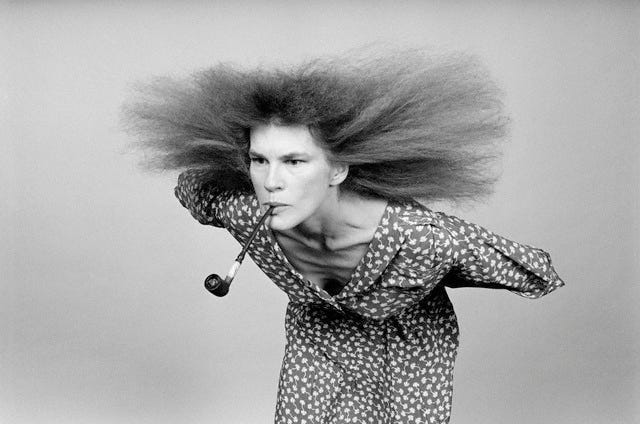
Paul Bley met Lovella May Borg (later Carla Bley) when she was a cigarette girl at Birdland.
(Carla) Bley arrived in New York in the mid-1950s when she arrived, and took menial jobs at local jazz joints so she could hear the music. She remembers in particular her gig as a cigarette girl at Birdland.
"I would stand right in front of the bandstand and hear all the great bands, all the great musicians — and sold very few cigarettes," she says. "If someone asked me for a pack of Luckies, I would say, 'Wait until the intermission.' I was not a good cigarette girl."
But Bley's larger career was just getting started. Her big breakout as a composer was a sprawling 1971 jazz opera called Escalator Over the Hill that involved dozens of musicians, including Jack Bruce, Charlie Haden, Paul Motian and Linda Ronstadt.3
In the 1990’s, Paul Bley recorded albums honouring his ex-wives. Annette (3.5 stars) was released by hatOLOGY records, recorded in April 1992 with Paul Bley on piano, Franz Koglmann on trumpet and flugelhorn, and Gary Peacock (Annette’s husband prior to Paul Bley) on bass.
Homage to Carla (4 stars) was released on Owl Records, also recorded in April 1992. It seems to be unavailable on Spotify in Canada and I can’t find the full album on Youtube. But here is the title track, “Homage to Carla:”
The Penguin Guide discusses the above two albums at length:
Anyone who remembers Bley’s live sets from Copenhagen and Haarlem will remember the sheer sensuous delight of tunes like ‘Touching’, ‘Blood’, and ‘Mr. Joy’, Annette Peacock compositions which both receive fresh and freshly delightful readings here on the reissue of Annette. The only non-Peacock item on the set is the improvised title track, which somehow manages to capture her essence. On take one of ‘Touching’ (a second closes the album), Bley can be heard singing along to his solo reading, which is as spare and unembellished as any he has done of the piece. ‘El Cordobes’ and the peerless ‘Cartoon’ follow, bringing in Peacock and Koglmann, and on the latter track the level of abstraction and timbral complexity increases a good deal.
One has the strong impression throughout the disc that theses are songs without words, which is much as they were written. Annette’s intention was to provide Bley with challenging environments for improvisation. As such, they are more open-ended and ambiguous than the wey, pungent themes he received from Carla Bley. The albums were recorded a fortnight apart, Annette in Sitzerland, Homage to Carla in New York City, solo and on a magnificent Bosendorfer that seems to chime and resonate with the slightest touch. Though Bley’s music uses the same dark, minor tonalities and untroubled dissonance, the two composers are very different and on the Carla album it is not so much melody and harmonic development one notices as the overall structure and colour of pieces like ‘Ictus’, ‘Closer’ and ‘Vashkar’, which have admittedly gained a certain familiarity from long use. Bley’s use of special techniques, like the softly dampened open strings on ‘Closer’, is sparing but stunningly good.
Two rather different sets, then, but devoted to the two most important musical associations of Bley’s life. As an inspiration and interpreter, he is without peer and theses sets underline his conviction that whether playing solo or in a group, improvisation is always a collaborative act.
The Jazz Composers Guild was founded by Bill Dixon stemming from the success of the first free jazz festival, “October Revolution in Jazz” in New York City October 1 - 4 1964. Paul and Carla Bley were active members of the Guild together.
While the free jazz innovations of the late 1950s had emphasized harmonic and formal freedom, it was during the mid-1960s that Bley and others associated with the Jazz Composers Guild began to explore the possibilities of playing in free time. Bley and other members of the Jazz Composers Guild were the subject of a 1981 film documentary Imagine the Sound.4

Imagine the Sound was directed by Canadian indie filmmaking stalwart, Ron Mann. I met Mann once, with his bushy tuft of gray hair, at a screening at the TIFF Cinemateque. I can’t remember what the film was, but I remember Mann. When I was working in film distribution, I always looked forward to crafting the pitch decks for his distribution outfit, Films We Like.
The documentary is a product of its time for sure, and can almost feel comical at times, like a mockumentary. But it features outstanding and idiosyncratic performances from Bley, Archie Shepp, Bill Dixon, and most memorably, Cecil Taylor.
In 1974, Bley started Improvising Artists Inc. with his third wife, video artist Carol Goss.
IAI was most active in the 1970s, when it developed a catalogue of recordings by Bley and other jazz artists and promoted an ambitious roster of jazz artists for live performance. Among the artists who recorded and toured with IAI were Lester Bowie, Jimmy Giuffre, Lee Konitz, Steve Lacy, Sun Ra, and Sam Rivers. In addition to audio recordings, Goss, Bley, and IAI produced commercial music videos; they were in fact credited by Billboard magazine as having introduced the commercial music video genre. Some IAI videos were jazz performance documentaries, and others were more abstract interpretations. Editing and mixing decisions in IAI videos were improvised simultaneously as the music was performed, to parallel the creative process of jazz.5
In the 1990’s, Paul Bley rekindled a relationship with Canada that he had left behind when he moved to the United States.
While his visits to Canada were infrequent in the 1960s and 1970s, Bley's connections with the Canadian jazz scene began to grow in the 1980s. Bley recorded, for Justin Time and other Canadian record labels, with several Canadian musicians including Jon Ballantyne, Jane Bunnett, Sonny Greenwich, Yannick Rieu, Herb Spanier, and Kenny Wheeler. He performed at Canadian jazz and new music festivals, including the Festival international de jazz de Montréal, which honoured him with a concert series in 1992 and which accorded him the Prix Oscar Peterson in 1994. In 1998, the Bravo! and Arte television networks broadcast a biographical documentary on Bley. In the early 1990s Bley added teaching to his career, when he joined the faculty of the New England Conservatory of Music. He was inducted into the Order of Canada in 2008.6
Here, I’ll focus on three Paul Bley records released by Justin Time and featured in The Penguin Guide to Jazz, Seventh Edition.7 The first, Know Time (3 stars), recorded in 1993, features Bley on piano, Herbie Spanier on trumpet and flugelhorn, and Geordie McDonald on drums and percussion. The Penguin Guide states:
A free session by three Canadians whose paths have crossed in different permutations over the years but who have never been able to preserve this type of gig on tape. McDonald is the wild card, a composer-improviser with a huge range of sounds at his disposal. Though the stated aim is the old one of finding a basis for improvisation that goes far beyond conventional song form, there is a persistent sense that this is exactly what lies behind those 13 shortish pieces. However, items like ‘Seascape', ‘Cave Painting’ and ‘Matrix’ do suggest that the prevailing analogy is not musical at all but the visual arts, and that these are not so much songs as images. They are less static than this suggests, and it is possible to hear Bley in particular hesitate between linear logic (never something has has been wedded to) and a more impressionistic, flat-plane sound that generates very different patterns of sound. Though in some respects it sounds unresolved and even uncertain, in years to come this may be seen as one of Bley’s most important later recordings, signalling yet another change of direction.
Outside In (recorded 1994) may be the record I was most drawn to of all the Paul Bley Justin Time albums, as it pairs Canadian guitarist Sonny Greenwich with Bley. Greenwich is somewhat of a cult musical figure in Canada, and jazz critic and author Mark Miller (The Miller Companion to Jazz in Canada) wrote a book about him, published in 2020, entitled Of Stars and Strings: A Biography of Sonny Greenwich . I’ve yet to read the book, but will include some illuminating excerpts from reviews here.
From the Hamilton Review of Books:
In general, Canadian cities are smaller than the major US centres; they spawn tiny alternative-music communities, and their Black neighbourhoods – throughout the 20th century, the originators and nurturers of jazz practice – are even smaller.
Out of one of these Black Canadian communities, however – in Hamilton, a mid-sized Ontario steel town – came a distinctive guitarist who had the potential to become a major jazz voice and influence on a level with the Americans who created and defined the genre. Sonny Greenwich should be a household name in Canadian music, and he would be, had he been better able to navigate the treacherous currents of the music business, both inside and outside Canada.
Greenwich, however, faces the historical disadvantage that all jazz musicians face – the fact that no matter how hard they work to get their music out there, even hundreds of performances before thousands of people don’t do much to build a permanent archive. Once music is played it is, as Eric Dolphy said, gone in the air. In all musics except classical music (with its canon of written scores), consecration usually depends on being recorded on a label that is well-funded and widely-distributed enough to have its own cachet (Billie Holiday on Verve, Miles Davis on Columbia, John Coltrane on Impulse!); the Greenwich discography, however, mostly consists of labels that, like him, have been hard-working, distinctively original, but perhaps a bit out-of-the-way – in short, essentially Canadian.8
Alexander Varty, of musicworks.ca, writes:
Greenwich’s discovery was that by applying abstract patterns to the guitar’s fingerboard—patterns largely inspired by the early twentieth-century modernist painter and mystic Paul Klee’s characteristic shapes—he could break out of conventional harmony. ‘The pattern can change, or I can play the pattern up or down depending on the chords that are passing as I’m soloing,’ he explained in a 2018 email to Miller. ‘I can leave the pattern and play melodically if I choose, or insert the pattern into the passing chords of the tune, which is what I do.’
The implications, audible in all of Greenwich’s recordings, have gone largely unsung in the wider world; what Miller is trying to accomplish with Of Stars and Strings is to tell that world that Canada, in the 1960s and afterwards, was home to a jazz innovator as daring as his contemporaries Eric Dolphy, Ornette Coleman, Miles Davis, and Wayne Shorter. That’s a claim backed up by Davis and Shorter, at least, who played briefly with Greenwich and were impressed by his adventurousness, emotional depth, and sound, which hovered on the edge of distortion well before fusion players brought that timbre into the jazz mainstream.
The closest Greenwich comes to defining his personal nexus of spirituality and sound is in the 1996 documentary It Ain’t All Jazz, in which he tells filmmakers Amos and Alfons Adetuyi that ‘there’s an energy and sweetness to this search, you know. You might hear it in my notes. Like, you might hear sweet notes. It’s my search for God you’re hearing.’9
I watched It Ain’t All Jazz, and while I appreciated watching Greenwich and his band play, there was little context for Greenwich’s story that placed it as part of a movement of cultural moment that I could latch onto. I’m not a big enough fan, I didn’t know enough about Greenwich and the others featured (Wray Downes on piano and Archie Alleyne on drums) to have an emotional stake in the documentary. But it’s still a rare and insightful look into three working Canadian jazz musicians.
The Penguin Guide to Jazz gives Outside In three stars:
A very spontaneous and - apparently - unrehearsed studio sessions following one of [Paul Bley’s] relatively rare concert appearances at the Festival International de Jazz de Montréal in 1994. The aim was to explore a batch of songs from without and within, working in both directions simultaneously. The process is easier to follow on the standard and repertoire material, a very oblique interpretation of ‘These Foolish Things’ and versions of Eldridge’s ‘I Remember Harlem’, ‘Rollins’s ‘Pent Up House’ and Charlie Parker’s ‘Steeplechase’, a nod in the direction of Bley’s other sponsoring label. Some of the material is clearly improvised on the spot or is based on material run down at the concert earlier. The playing is calm, detailed and resolutely un-intense. If improvising players now try to resist the ‘conventional’ analogy for what they do, this records seems to restore it. It’s full of the elisions, repetitions, non-sequiturs and sheer playfulness found in any dialogue between friends, old or new.
In 1995, Bley released the solo effort, Sweet Time (3 stars), for Justin Time. The Penguin Guide:
Sweet Time is a fascinating set that underlies how deeply Bley is immersed in the blues, gospel, ragtime and a host of other piano idioms. The title piece is a clotted blues rag, densely structured but rhythmically pungent. ‘Contrary’ draws on a host of classical references, some explicit, most of them very carefully absorbed into the structure. ‘Never Again’ is one of his seemingly spontaneous compositions, a minimal line packed with information and with emotion. ‘Turnham Bay’ seems to relate to something deeply personal and is as lovely as anything he’s produced in years, while ‘Pointillist’ is a return to a more abstractionist approach.
The album’s cover features a photo of a street corner fish and chips spot, with a street sign “Charlevoix,” ostensibly a throwback to the “sweet time” of his youth in Montreal.
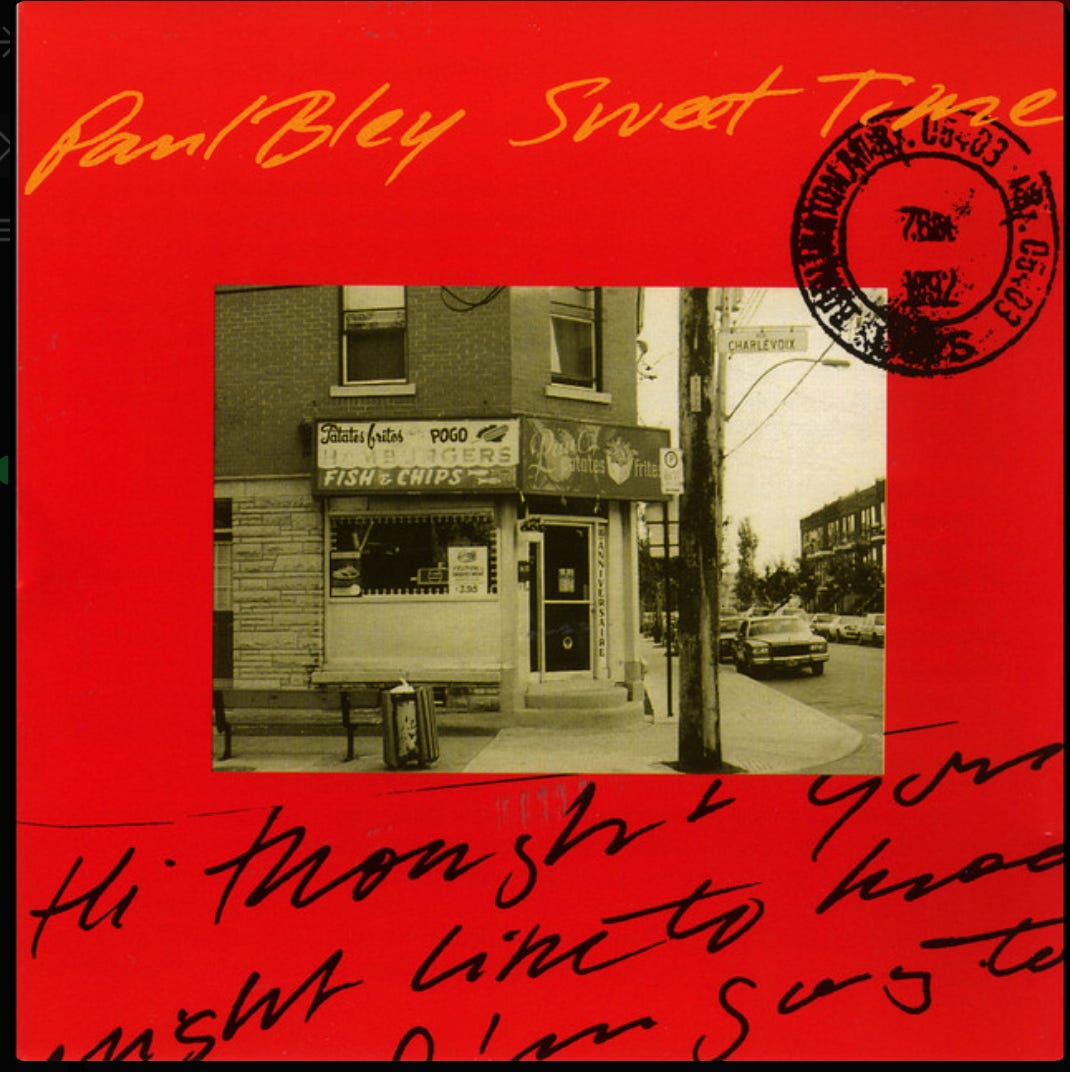
The album was also reviewed by ALL MUSIC writer Thom Jurek, whose praise overflows:
Sweet Time, like the albums Open, to Love, Hands On, Tears, and Changing Hands, is an elliptical, mystifying masterpiece that displays Bley's uncanny knack for creating crystalline, gleaming musical structures from the most minimal of means. Take for instance a spontaneous balladic composition such as "Never Again," with its gently dissonant skeletal body that becomes a ghostly study in intervallic extension -- along a row of eight notes and a host of chords built from their rearrangement into a new architecture, equally spare but far from sparse. It's a piece that requires an emotional response to enter initially because so little is apparent to the ear. When, in the middle of the tune, he shifts into droning regal chords and staggering arpeggios that leap into the scalar heavens from the original chords and pitches, the effect is stunning, breathtaking. On the tune "Contrary," Bley constructs two-handed melodic counterpoint. In the top middle register he flows scales and arpeggios together that stagger one another, while in the lower middle register he undoes them by taking the root note of the root chord and reflecting the second, not the current, arpeggio in the right hand. In the lower scale he moves through both Handel and Pachelbel for grins before striking it all and entering into a quick study of minor sevenths and diminished ninths. On the title track, Bley reveals what makes him a legend in the history of jazz and not -- as the snot-nosed new breed of "cultural" critics would have him -- a footnote. Bley moves a standard ragtime meter and creates a rhythmic counterpoint by shifting into deeper blues waters. Here again, in the lower middle register of the piano, Bley finds the elemental means by which to construct a narrative that is at once elliptical yet rooted in traditions so old you can smell the dirt. Fats Waller, Jelly Roll Morton, Bud Powell, and Roosevelt Sykes all make their voices heard in Bley's blues. As if that wasn't enough, he shifts his focus briefly to a different kind of blues: Occidental and Oriental blues, as if trying to create a musical mythology in scalar phrases and open, droning, modal chords. There are places in Bley's music, especially when he digs in, playing an idea over and over again and altering it note by note until it suddenly emerges in an entirely new construct, that spoken -- or in this case written -- language ceases to have meaning because it cannot convey even a simile of what is transpiring in the music. That Bley's music is original is a given, that its beauty is towering is an understatement, that it can only be comprehended in the depths of the human heart is simply the truth.10
Here is the title track that Jurek refers to above, while taking shots at “the snot-nosed new breed of ‘cultural’ critics.” This track, and the album, serve as admirable showcase for Bley’s technique, his feeling, his je ne sais quoi. “You never play where you are,” Bley says. “You play where you’re going…. I can hear a whole solo in advance – not note for note but structurally.”11
Before I left for Portugal, a few weeks ago, it was a blindingly sunny day after what felt like two weeks of constant grey skies, rain, freezing rain, snow, high-speed winds, sleet, flurries. In other words, March in Toronto. I took a walk to Hillcrest Park, perhaps connecting it in my mind to the famous Hillcrest Club sessions that Paul Bley recorded with Ornette Coleman et al. I finally got a new pair of ear buds after my air pods were stolen months ago from Toronto General Hospital, where I spent a week fighting lyme disease. I would be moving house in a couple weeks, had been unemployed for over a year. But I knew I’d be going to teacher’s college in the fall, I knew I’d be moving to a nicer place. Spring was coming… before June. In that moment,I sat down on a park bench and stared into the sun listening to Paul Bley solo, closing my eyes as the snow finally melted. I thought of my mortality, my children, how much I love my wife, how much I appreciate my therapist. Through the ear buds, in another realm, Paul Bley’s piano connected my meditation to something tangible. And in that moment, Paul Bley felt my pain and my hopes and desires. I felt it through his music, too. I swear.
https://quillandquire.com/review/stopping-time-paul-bley-and-the-transformation-of-jazz/
https://www.scaruffi.com/vol3/peacock.html
https://www.npr.org/2016/05/19/478692554/at-80-carla-bley-keeps-looking-towards-the-next-composition
https://www.thecanadianencyclopedia.ca/en/article/paul-bley-emc
Ibid
Ibid
After 40 years and over 600 recordings released by some of Canada’s finest musicians, Justin Time Records founder Jim West steps down from his role to focus on his management firm, Wild West Artist Management. The Montreal-based label will now be owned by Nettwerk Music Group, a respected Canadian music company with offices in Vancouver, New York, London, Los Angeles and Hamburg. They also house their own record label, publishing house and artist management firm.
Prior to founding Justin Time Records in 1983, West started his music management career in the 1970s as a road manager for Canadian rock band Mahogany Rush. However, when West heard pianist Oliver Jones play at Montreal’s Biddles Jazz Club, it served as the inspiration for him to start a record label as a way to amplify Canadian music. Oliver Jones’ Live at Biddles was the first record released on Justin Time Records in 1983.
Source: https://jazz.fm/justin-time-records-founder-jim-west-steps-down-after-40-years/
https://hamiltonreviewofbooks.com/blog/2021/06/09/david-neil-lee-reviews-mark-millers-of-stars-and-strings-a-biography-of-sonny-greenwich
https://www.musicworks.ca/reviews/mark-miller-stars-and-strings-biography-sonny-greenwich
https://www.allmusic.com/album/sweet-time-mw0000644805
https://quillandquire.com/review/stopping-time-paul-bley-and-the-transformation-of-jazz/